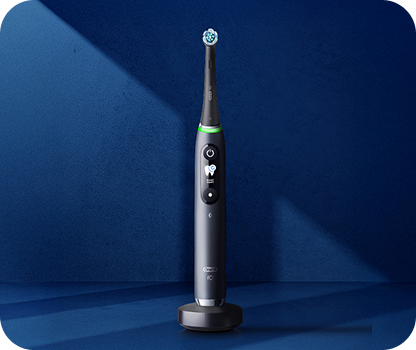






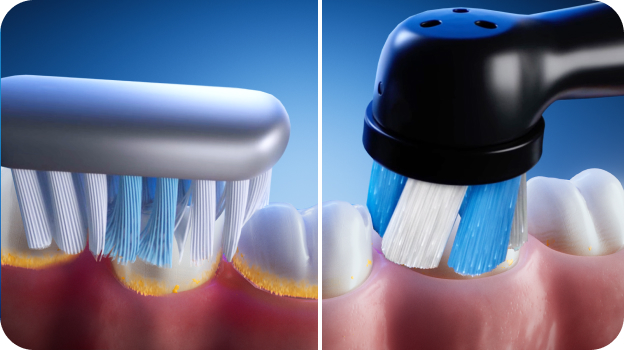






Macro shot of an Oral-B iO brush head cradling a glass marble to show how bristles conform to tooth contours.

Electric Toothbrushes

What Causes Tooth Sensitivity — and How Oral-B iO Helps

10 minute read

Last updated 08/2026

Dr. Robert Lee, a dental professional with 35 years of experience.

Approved and reviewed by Dr. Gans, a dental professional of over 10 years.

Learn More
  • Contents

  • How Oral-B iO Supports Gentle Brushing
  • What Causes Tooth Sensitivity?
  • How Oral-B iO Supports Gentle Brushing:
  • What to Expect When Switching to Oral-B iO
  • The Bottom Line: Designed for Gentle Brushing
  • FAQ: Quick Questions on Tooth Sensitivity and Oral-B iO
  • Sources

Quick hit key takeaways

1

A different feel — but a gentle one. Oral-B iO's round head engages each tooth directly, creating a different sensation than sonic vibration. That feel is designed to be gentle, not intense, while helping clean along the gum line to support healthy gums.

2

Designed to support gentler brushing habits. Tooth sensitivity can have several causes, including gum recession and enamel wear from factors such as brushing pressure or acid exposure.¹ The Visible Pressure Sensor signals when you're brushing too hard and automatically slows down, and the round brush head removes plaque along the gum line to support healthy gums.

3

Try the Gum & Sensitive brush head. It has the thinnest bristles in the Oral-B range and is designed for a gentle yet effective brushing experience — a good option if your teeth or gums feel tender.*

How Oral-B iO Supports Gentle Brushing

Oral-B iO's oscillating-rotating technology is designed to support gentle brushing. It cleans tooth by tooth rather than gliding across your teeth, pairs that motion with feedback when you're pressing too hard, and removes plaque along the gum line to help support healthy gums.²

Together, these features can help support better brushing habits — even though tooth sensitivity can have several causes.

Why Oral-B iO Feels Different from a Sonic Toothbrush

A sonic toothbrush uses small, high-frequency vibrations and is typically used more like a traditional manual brush, with a longer brush head that can reach several teeth at once.

Oral-B iO feels different because its small round head is designed to surround each tooth and clean tooth by tooth.² Instead of spreading vibration across a longer brush head, iO concentrates motion at the bristle tips, creating a more focused brushing sensation.

That focused action helps the brush do the cleaning work for you — along the gum line and in hard-to-reach areas where plaque can build up — for a more effective clean.

Why Oral-B iO feels different:

  • Oral-B iO — uses a small round brush head that surrounds each tooth, while the iO drive directs energy to the bristle tips for focused, tooth-by-tooth cleaning.²
  • Sonic — typically uses a longer brush head with high-frequency vibration, so the brushing experience can feel more like moving a manual toothbrush across several teeth at once.

Round brush head: precise cleaning along the gum line

The small round brush head is designed for precision. It surrounds each tooth to help clean tooth by tooth, including along the gum line and in hard-to-reach areas like the backs of teeth.²

This focused cleaning action helps remove plaque where it can build up — an important part of supporting healthy gums.

What Causes Tooth Sensitivity?

Tooth sensitivity can happen for many reasons. Common causes include gum recession, worn enamel, tooth decay, cracked teeth, recent dental work, whitening products, teeth grinding, and enamel wear from factors such as brushing pressure or acid exposure.¹

When sensitivity is related to everyday brushing habits, brushing too hard is one factor to watch because too much pressure can irritate the gum line and may contribute to gum recession over time.

Gentler brushing habits can help reduce brushing-related irritation and support gum health.

Everyday brushing habit: brushing too hard

Pressing too hard while brushing can irritate the gum line and may contribute to gum recession over time, which can make teeth feel more sensitive if the tooth root becomes exposed.

Gum-related factor: gum recession

Gum recession happens when gum tissue pulls back from the tooth, which can expose the root surface underneath. Because roots are not protected by enamel the same way the crown of the tooth is, exposed roots can feel more sensitive.

Gum recession can have several contributors — including brushing pressure, gum disease, genetics, and other factors — so gentle brushing and daily plaque removal along the gum line are important.

How Can Oral-B iO Support Gentler Brushing Habits?

Oral-B iO helps make gentler brushing easier by giving you feedback while you brush. The Visible Pressure Sensor lets you know when you're pressing too hard and automatically slows the brush,* while the iO drive helps the brush do the work at the bristle tips.²

Its round head cleans tooth by tooth along the gum line, helping remove plaque where it can build up.

How Oral-B iO Supports Gentle Brushing:

  • iO drive technology — directs energy to the bristle tips, helping the brush do the cleaning work for you.²
  • Visible Pressure Sensor & feedback — signals when you're pressing too hard and automatically slows the brush, helping you ease up before over-brushing becomes a habit.*
  • Round brush head — surrounds each tooth and cleans along the gum line, helping remove plaque in hard-to-reach areas.
  • Sensitive and Super Sensitive modes — provide lower-intensity brushing options for tender teeth and gums.*
  • Gum & Sensitive brush head — has the thinnest bristles in the Oral-B range and is designed for a gentle yet effective brushing experience.*
  • Quieter operation — Oral-B iO is 2X quieter than the Oral-B Pro Series, which may make brushing feel more comfortable if loud brushes bother you.*

The clinical evidence

Keeping plaque under control is an important part of helping keep teeth and gums healthy. Oral-B iO is designed to make that easier with focused, tooth-by-tooth cleaning along the gum line and in hard-to-reach areas.

In an 8-week clinical study, Oral-B iO removed more plaque than a leading sonic toothbrush:⁴

  • 28.5% more plaque overall vs. a leading sonic toothbrush⁴
  • 41.4% more plaque in hard-to-reach/proximal areas vs. a leading sonic toothbrush⁴
  • 48.7% more plaque along the gum line vs. a leading sonic toothbrush⁴ — helping remove plaque where it can build up

The key difference: Sonic brushes typically use a longer head with high-frequency vibration, while Oral-B iO concentrates synchronized motion at the bristle tips, tooth by tooth.²

What to Expect When Switching to Oral-B iO

If you're switching from a manual or sonic brush, Oral-B iO may feel different at first. That's because the round brush head is designed to surround each tooth and clean tooth by tooth, while the iO drive helps the brush do the work at the bristle tips.

  • Start with Sensitive mode — or Super Sensitive if your model has it — to ease into the new brushing feel.*
  • Guide, don't scrub — let the round brush head move tooth by tooth while the iO drive does the cleaning work.
  • Watch the pressure feedback. The Visible Pressure Sensor helps you know when you're pressing too hard, so you can ease up before over-brushing becomes a habit.*

The Bottom Line: Designed for Gentle Brushing

Sensitivity can have many causes, but brushing habits still matter. Brushing too hard can irritate the gum line and may contribute to gum recession over time, while enamel wear can come from multiple factors, including brushing pressure and acid exposure.¹

Oral-B iO helps support gentler brushing with pressure feedback, Sensitive modes, and a round brush head designed to clean tooth by tooth along the gum line. It may feel different from a sonic toothbrush, but that difference is by design: focused cleaning that helps remove plaque where it can build up.

Shop this article

1222|1493|1489|1502

FAQ: Quick Questions on Tooth Sensitivity and Oral-B iO

What causes tooth sensitivity?

Tooth sensitivity can happen when enamel is worn down or the tooth root becomes exposed. Common causes include gum recession, tooth decay, cracked teeth, recent dental work, whitening products, teeth grinding, and enamel wear from factors such as brushing pressure or acid exposure.¹

How does Oral-B iO help if I brush too hard?

The pressure sensor helps by signaling when you're pressing too hard and automatically slowing the brush, so you can ease up while the brush does the cleaning work.

Does Oral-B iO feel more intense than a sonic toothbrush?

It feels different, not more intense. Oral-B iO's round head cleans tooth by tooth, while a sonic brush typically has a longer head that can reach several teeth at once. The iO drive focuses motion at the bristle tips for a more targeted brushing feel.²

Is the round brush head gentle on sensitive gums?

Yes. The round head surrounds each tooth and cleans along the gum line. For tender gums, the Gum & Sensitive brush head offers the thinnest bristles in the Oral-B range and is designed for a gentle yet effective brushing experience.

Is Oral-B iO still effective if it's designed to be gentle?

Yes. Oral-B iO is clinically proven to remove more plaque than a regular manual toothbrush, so gentle brushing and effective cleaning can work together.³

What should I expect switching from a sonic toothbrush?

Expect a more focused, tooth-by-tooth brushing feel. Start with Sensitive mode if your model has it, guide the brush instead of scrubbing, and use the pressure feedback to help avoid pressing too hard.

Sources

  • 1. American Dental Association. (2003). Sensitive teeth: Causes and treatment. The Journal of the American Dental Association, 134(12), 1691.
  • 2. Adam, R. (2020). Introducing the Oral-B iO electric toothbrush: Next generation oscillating-rotating technology. International Dental Journal, 70(Suppl 1), S1–S6. https://doi.org/10.1111/idj.12570
  • 3. Grender, J., Goyal, C. R., Qaqish, J., & Adam, R. (2020). An 8-week randomized controlled trial comparing the effect of a novel oscillating-rotating toothbrush versus a manual toothbrush on plaque and gingivitis. International Dental Journal, 70(Suppl 1), S7–S15. https://doi.org/10.1111/idj.12571
  • 4. Adam, R., Goyal, C. R., Qaqish, J., & Grender, J. (2020). Evaluation of an oscillating-rotating toothbrush with micro-vibrations versus a sonic toothbrush for the reduction of plaque and gingivitis: Results from a randomized controlled trial. International Dental Journal, 70(Suppl 1), S16–S21. https://doi.org/10.1111/idj.12569
  • 5. Goyal, C. R., Adam, R., Timm, H., Grender, J., & Qaqish, J. (2021). A 6-month randomized controlled trial evaluating a novel smart-connected oscillating-rotating toothbrush versus a smart-connected sonic toothbrush for the reduction of plaque and gingivitis. American Journal of Dentistry, 34, 54–60.
  • 6. Zou, Y., Grender, J., Adam, R., & Levin, L. (2024). A meta-analysis comparing toothbrush technologies on gingivitis and plaque. International Dental Journal, 74(1), 146–156. https://doi.org/10.1016/j.identj.2023.06.009
  • 7. Luo, C., Chen, N., Jing, Q., Hu, S., Wan, S., Zhang, S., Liu, G., Li, N., & Zhao, L.-Y. (2026). Comparative efficacy of electric toothbrush technologies in plaque and gingivitis reduction: A network meta-analysis. Clinical Oral Investigations, 30, 270. https://doi.org/10.1007/s00784-026-06955-z
  • 8. Thurnay, S., Adam, R., & Meyners, M. (2022). A global, in-market evaluation of toothbrushing behaviour and self-assessed gingival bleeding with use of app data from an interactive electric toothbrush. Oral Health & Preventive Dentistry, 20, 1–10. https://doi.org/10.3290/j.ohpd.b2572911